


_edited.png)
The Triathlete’s Priority Pyramid: How to Build a Smart Training Week| The Triathlete Blueprint #138

Read time: 6min.
By Coach Yan Busset
You know, life is busy ...
Now we’re getting into Christmas and New Year, for some people that means suddenly more time to train, for others it means the opposite: family everywhere, travel, food, kids off school, zero routine.
But honestly, it doesn’t matter which week of the year it is, I am coaching age groupers. You have a job, a family, other hobbies ( if you have time for other hobbies, we need to talk you probably don´t train enough) a brain that is sometimes tired. You need to juggle life, not live like a full-time athlete.
So the real question is: when time and energy are limited, what do you actually prioritise?Because you cannot do everything. And trying to do everything is usually the fastest way to do nothing properly.
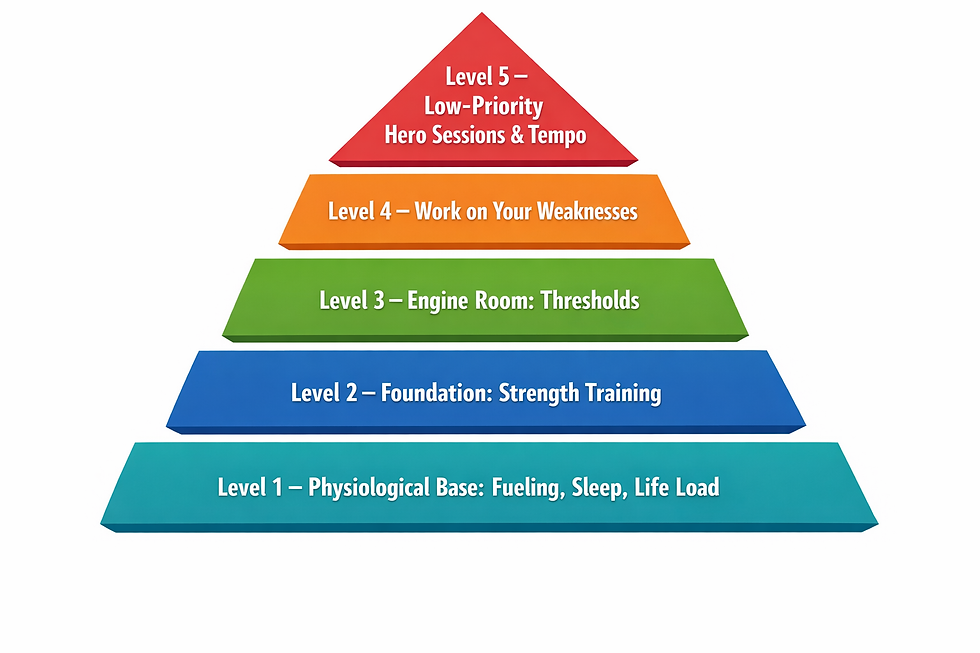
What I want to give you here is a kind of Maslow pyramid for triathlon training. Five levels. When life explodes, you start at the bottom, and you keep as many levels as you can. When you run out of time, you stop. Simple.
Level 1 – Physiological base: fuel, sleep, life load
The very bottom of the pyramid is not training. It’s fueling, sleep and your overall life stress.
If you mess this up, nothing else really works.
If you have a crazy stressful day at work, you come home late, you haven’t eaten properly, and the only free slot is at 22:00… you have to ask yourself: is it really worth it?
Most of the time the answer is no. Because you go and smash yourself late in the evening, you compromise your sleep, and then tomorrow you are even more tired. Congratulations, you just trained on credit. And the body always sends the bill, with interest.
So instead of trying to be a hero at 22:00, change the habits. Move the key stuff to the morning. Yeah, I know, you “are not a morning person”. Too bad. If life is busy and you want to be good at triathlon, something has to change. Go to bed earlier, wake up earlier, train, and then start your day. But don’t constantly sacrifice sleep. Recovery is not optional.
That’s level one. If this level collapses, the rest of the pyramid is just decoration.
Level 2 – Foundation: strength training
Once you protect the basic human stuff, then the first training priority for me is not what most endurance athletes expect.
It’s strength training.
Heavy-ish weights. Pushing, pulling, lifting. Making the body more resilient. Why is it number one? Because every time you do a good strength session, it helps your swim, it helps your bike, it helps your run. It’s a three-in-one type of training. You build the structure that can actually handle the endurance work.
Without foundations, the house crumbles. And I see it all the time: people are very “fit” on paper, nice FTP, nice paces, but the tendons and joints and muscles are made of glass. One little increase in volume and boom, they are injured.
So in a busy week, if everything goes wrong and you can only keep one session, honestly, I would try to keep the gym session. That’s how high it is in the pyramid.
Level 3 – Engine room: thresholds (plural) and a polarised week
Then we go to the engine room. This is where we talk about thresholds – with an S – and polarised training.
For me, there are two important points in your fitness:
the aerobic threshold, that high Zone 2, the top of your “easy” range
the anaerobic / lactate threshold, that harder edge where you can still sustain some work
We want to push both of them up over time.And we want to do it in a polarised way. Roughly 80% of your training easy, 20% hard. It doesn’t matter if you have 6 hours or 16 hours, the idea is the same: most of the time you cruise, sometimes you push, and you avoid living in the “kind of hard” grey zone every day.
High Zone 2, around the aerobic threshold, that’s your buffet. You can spend a lot of time there. Long rides, steady runs, all that boring endurance – this is where the durability comes from, and it’s still in the “easy” bucket.
The anaerobic threshold stuff, that’s the spice.Intervals, more structured work. That one quality session on the bike or one on the run in a busy week. Small, smart doses. This is not “let’s die for 60 minutes non-stop”. It’s controlled, and it fits into that 20% hard.
So this level of the pyramid is: build the engine with lots of good Z2, and just enough proper hard work, in a polarised week.
Level 4 – Work on your weaknesses
Okay, now we have a functioning human, some strength, and an engine that is trained in a sensible way. Only here we start to ask: where do I put the focus?
This is where you work on your weaknesses.
And this is uncomfortable, because we all love to train what we are good at. If you are a petrol head, you love the short, hard efforts. If you are a runner, you love the run. If your swim sucks, you somehow manage to have “no time” exactly when it’s time to go to the pool.
But progress comes from training what you need, not what you like.
If your swim is the limiter, then sorry, swim gets priority in the week. If your base endurance is poor, then Zone 2 volume is your priority.If you already have great top-end, you don’t earn even more intensity – you earn more strength and more aerobic work.
So before you plan the week, you can simply ask: “What would move the needle the most in the next two months? ”That answer should shape this level of the pyramid.
Level 5 – Low-priority layer: hero sessions and tempo
And then, finally, at the very top, the little triangle where everybody wants to live: hero sessions and tempo.
You know exactly what I mean by hero sessions. Five-hour Zwift epics. Thirty-kilometre long runs “just to see”. Massive group rides where the pace is way too high for way too long, but hey, it looks cool on Strava.
They feel amazing in the moment, but they cost you a lot of recovery. If you only have a few hours per week, spending half of your weekly energy on one single heroic day is almost never a good deal.
Same with tempo, with Zone 3. It’s not evil, but it’s sneaky. It’s not easy enough to recover well, it’s not hard enough to really push your thresholds. It just makes you tired. And time-crunched athletes love to sit there, because it feels “like a workout”, but it’s usually not the smartest use of their limited time.
So this stuff is on the pyramid, but it’s the lowest priority. You add it when the other levels are solid. And when life gets busy, this is the first thing that goes out of the window.
So that’s the idea.Five levels, like a Maslow pyramid for triathletes:
Physiological base – fueling, sleep, life load
Foundation – strength training
Engine room – thresholds (plural) in a polarised week
Work on your weaknesses
Low-priority layer – hero sessions and tempo
When you look at your week, especially around crazy periods like Christmas, just climb this pyramid from the bottom. Take what fits. Drop what doesn’t.
And if something has to go, let it be the ego stuff at the top, not the boring foundations at the bottom.
Christmas gift idea 🎁
If you feel it’s time to bring your swim to the next level, swim faster, stop worrying about the swim leg in triathlon, and arrive in T1 fresh instead of exhausted – I have a Christmas gift idea for you.
I created a 12-week 70.3 Swim Breakthrough Program for athletes who are ready to commit to three structured swim sessions per week and want a clear plan instead of random tips.
And if you know someone who always suffers through the swim and would benefit from coming out of the water with more ease and confidence, feel free to share it with them too.
All the details and the application here: https://www.tri-coaching-finland.com/70-3-swim-breakthrough
Check out my NEW Youtube VIDEO!
Whenever you’re ready, there are 2 ways I can help you:
1. If you are in the Helsinki/ Espoo area and looking for the best training group check here
2. If you are looking for an online coaching service check here.
Join our newsletter subscribers and
get actionable training tips every week


Comments